
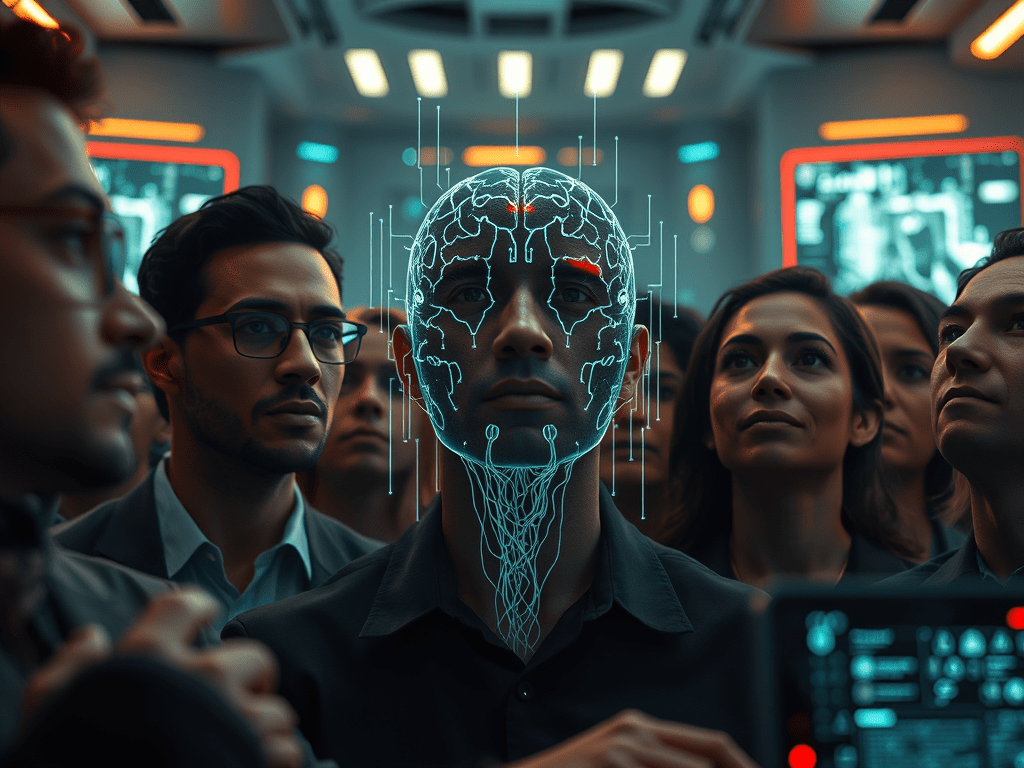
The future of leadership development may look radically different from today. We are on the cusp of a technological revolution that could enable leadership skills to be uploaded directly into the human brain — bypassing years of education, mentoring, and trial-and-error experience.
Imagine a scenario inspired by The Matrix, where Neo downloads the ability to fight, speak multiple languages, or pilot a helicopter in seconds. Now apply that to leadership:
- “History of Leadership” program: understanding centuries of leadership evolution and philosophy.
- “EQ Leader” module: embedding deep emotional intelligence and empathy into your neural patterns.
- “Empowering Leaders” suite: programming skills for influence, coaching, and delegation.
In such a world, the old debate — are leaders born or made? — becomes both irrelevant and strangely literal. Future leaders could be genetically predisposed to leadership traits before birth (via CRISPR or similar gene-editing technology) and later have leadership skills programmed directly into their brain via neuro-interfaces.
The ethical questions are enormous: Should leadership be “engineered” in this way? Would society allow such interventions? Who decides what “good leadership” is? While these questions remain unresolved, the technology trajectory suggests it will be possible within decades.
The Critical Principle: Change Thinking to Change Behaviour
One principle remains constant — even in a hyper-technological future:
If you want to change behaviour, you must first change the thinking behind the behaviour.
This is the foundation of cognitive-behavioural theory, which asserts that our thoughts shape our emotions, which in turn drive our behaviours. In leadership, this means that addressing poor, dysfunctional, or outdated leadership behaviour requires shifting the underlying mental models.
Two questions arise:
- Can behaviour change happen before thinking changes?
Behavioural “nudges” (Thaler & Sunstein, 2008) can shape action without conscious thought, but without deeper cognitive change, these shifts are often temporary. - Do leaders need experiences that provoke new thinking?
Research on transformative learning (Mezirow, 1991) suggests that leaders often need a “disorienting dilemma” — a challenging or uncomfortable experience — to trigger reflection and reframe their perspective.
Current Pathways to ‘Programming’ Leadership Without Direct Brain Interfaces
While we can’t yet jack leadership programs into the brain, we can design development systems that effectively rewire thinking over time.
1. Experiential Learning (Immediate Impact)
Immersive leadership simulations, cross-functional projects, and real-world stretch assignments provide “aha” moments that shift leaders’ perspectives quickly.
- Case Study: At Unilever, senior leaders participate in “Leadership Labs” where they work on live global sustainability challenges. Feedback loops and coaching ensure behavioural insights stick.
2. Strategic Leadership Content (Long-term Impact)
A sustained leadership content strategy can subtly reprogram thinking. Leaders receive consistent, strategically aligned messages about values, decision-making, and behaviours.
- Case Study: Microsoft’s “Growth Mindset” campaign under Satya Nadella embedded cultural and leadership shifts through repeated storytelling, internal communications, and leadership exemplars over years — leading to measurable shifts in innovation and collaboration.
From Thought Leadership to Thought Engineerin
When thought leadership is strategically planned and aligned to business strategy, it becomes a subtle yet powerful tool to reshape leaders’ thinking and behaviours.
This approach:
- Reinforces organisational values.
- Models desired leadership behaviours.
- Prepares leaders for the emerging world of AI, automation, and remote-first workplaces.
As VR, AR, and metaverse-based simulations mature, we will see “thought engineering” — the ability to run leaders through hyper-realistic, emotionally rich scenarios that train their judgment, resilience, and empathy in safe yet impactful environments.
The Question for Today
The future is moving towards neuro-enhanced leadership. Until that day arrives, organisations must ask:
- Are we building traditional leaders who can only function in today’s environment?
- Or are we creating future-ready leaders whose thinking is agile, inclusive, and adaptive enough to thrive in tomorrow’s unknowns?
The leaders of the future will not just manage people — they will integrate with technology, navigate ethical dilemmas of human enhancement, and shape a world where the line between human potential and machine augmentation is increasingly blurred.
The challenge for today’s leadership developers is clear: we must lay the cognitive groundwork now so that when technology catches up, our leaders will be ready not just to lead effectively — but to lead wisely.

Leave a comment